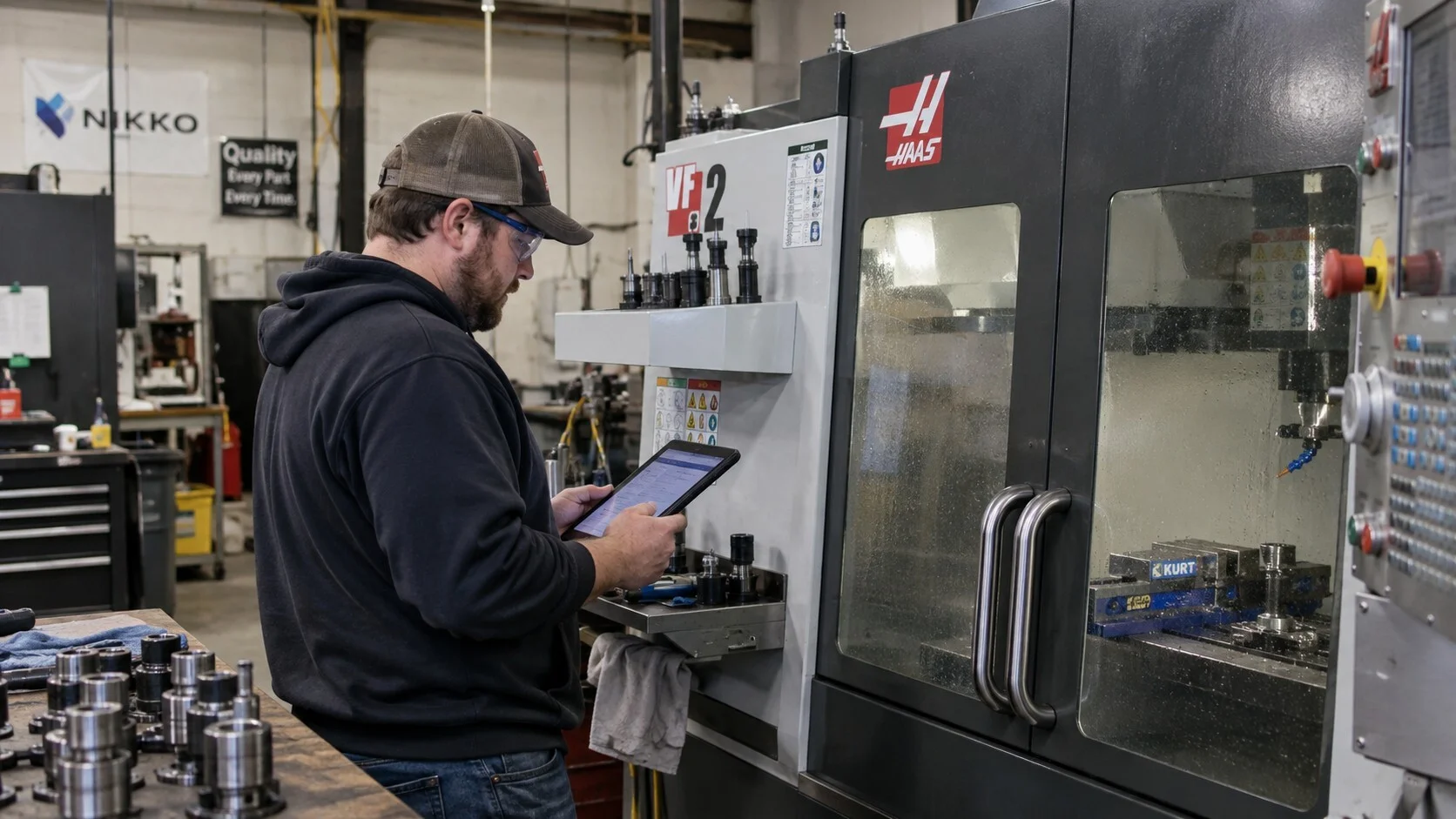
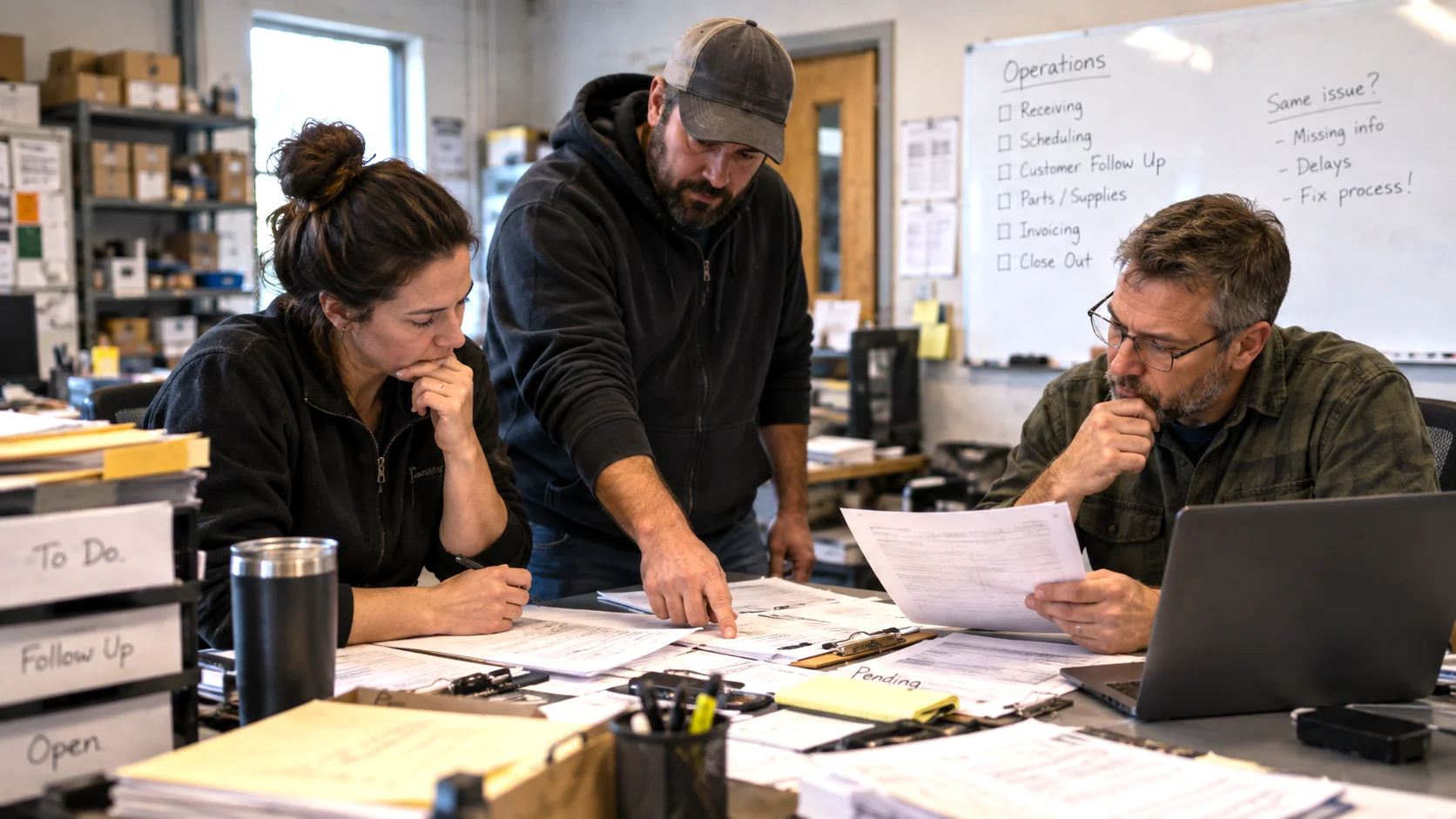
If you just muttered 'yep,' excellent. We found a scent.
WHERE DOES THE FRICTION HIDE?
Oh, pretty much everywhere.
Anywhere people, software, paperwork, money, stock, machines, customers, and deadlines pass a baton, somebody can drop it.
This is the tiny public version of our internal process map. Tiny. We like you too much to dump the whole thing on one webpage.
1. SELL SOMETHING+
Leads arrive from five places and nobody owns the first move.
Prospecting means hours of research and copy/paste.
Quotes need pricing, history, approvals and a small archaeological dig.
Follow-up lives in calendars, inboxes and human guilt.
Marketing data exists. Attribution is more of a spiritual belief.
Things we might build or fix: lead research/routing, qualification workflows, quote/proposal systems, pricing and margin controls, pipeline cleanup, campaign tracking, review/reputation flows, renewals, win-back and account-growth systems.
2. FIGURE OUT WHAT THE HELL WE ARE SELLING+
Product or service data is different depending on where you look.
Costs changed. Prices did not. Oops.
Bundles, options and rules live in somebody's head.
A new offering requires changing six systems and four documents.
Nobody notices a shrinking margin until it has already shrunk.
Things we might build or fix: master product/service data, cost and price synchronization, margin alerts, offer configuration, catalog publishing, change propagation and performance tracking.
3. DO THE WORK+
Sold work arrives incomplete.
Scheduling is part software, part phone call, part witchcraft.
Office, field, production and warehouse all know different versions of the truth.
Exceptions hijack the normal flow.
The job is finished, but the business systems have not noticed.
Things we might build or fix: work intake, planning, scheduling, dispatch, task assignment, status tracking, handoffs, exception management, change orders, quality control, completion triggers and capacity visibility.
4. BUY STUFF+
People request materials by email, chat, hallway conversation and telepathy.
RFQs come back in different shapes and somebody normalizes them by hand.
Purchase orders wait for approval. Then suppliers change the date anyway.
Reordering starts when someone notices the shelf looks sad.
Vendor invoices do not quite match the PO or the receipt. Surprise.
Things we might build or fix: purchase requests and approvals, supplier sourcing, RFQ comparison, PO workflows, reorder logic, supplier-performance tracking, price-change monitoring and invoice matching.
5. STORE IT. FIND IT. SHIP IT.+
The system says twelve. The shelf says nine.
Picked items disappear into staging purgatory.
People keep checking stock, committed stock and incoming stock in different places.
Shipping decisions require carrier tabs, spreadsheets and memory.
Returns take a scenic tour before anyone knows what to do with them.
Things we might build or fix: inventory visibility, receiving, bin/location control, picking and packing flows, cycle counts, carrier selection, shipping documents, tracking alerts, delivery routing, returns and claims.
6. DEAL WITH CUSTOMERS AFTER THE SALE+
The same status question gets answered 37 times.
Support requests land wherever the customer felt like sending them.
Complaints become private detective work.
Refunds, warranties and returns need five approvals and a moon phase.
Renewals and reorders happen when somebody remembers.
Things we might build or fix: request intake and routing, status communication, appointment coordination, complaint handling, returns/refunds, warranty workflows, retention, reorder reminders and voice-of-customer analysis.
7. MONEY. GLORIOUS, CONFUSING MONEY.+
Finished work waits to become an invoice.
Collections happen when somebody finally looks at aging.
Vendor invoices need coding, matching and approvals. Again.
Cash position is technically knowable after three exports.
Quoted margin looked great. Actual margin has left the chat.
Things we might build or fix: billing triggers, AR reminders, credit workflows, AP matching, expense flows, bank reconciliation support, cash visibility, job costing, profitability analysis, budgets and management reporting.
8. RUN THE PLACE WITHOUT GUESSING+
KPIs arrive after the meeting they were needed for.
The owner has a dashboard. It is called "asking everybody."
Forecasts are rebuilt manually and trusted emotionally.
Approvals pile up with one person.
Action items leave meetings and enter the witness-protection program.
Things we might build or fix: KPI collection, dashboards, exception review, forecasting, planning, resource allocation, approval flows, performance monitoring, meeting follow-up, internal-project control and problem management.
9. PEOPLE, PAYROLL & OTHER HUMAN ADVENTURES+
Hiring paperwork breeds paperwork.
New people spend week one asking where everything is.
Schedules, time off, overtime and shift swaps become group-chat archaeology.
Training and certifications expire quietly.
Someone leaves. Their access does not. Lovely.
Things we might build or fix: recruiting workflows, onboarding, employee scheduling, time and attendance, payroll inputs, training/certification tracking, performance processes, leave, compensation and offboarding.
10. CONTRACTS, RULES & PLEASE DON'T GET FINED+
Contracts have dates. Nobody loves tracking the dates.
Licenses, permits and insurance certificates expire on their own schedule.
Compliance evidence exists somewhere. Probably.
Claims need documents from six people.
Records are kept forever because nobody knows when they can die.
Things we might build or fix: contract lifecycle, renewals and obligations, permit/license calendars, insurance compliance, regulatory evidence, claims/dispute files, privacy requests, record retention and audit preparation.
11. SOFTWARE, DATA & THE OFFICE SWAMP+
Customer data has three spellings and two birthdays.
One system says paid. Another says unpaid.
Employees copy information between software because the software refuses to shake hands.
The shared inbox is a swamp with flags.
The company knowledge base is mostly "ask Sarah."
Things we might build or fix: integrations, data synchronization, data cleanup/master data, document extraction, reporting pipelines, access workflows, software/license management, email routing, internal requests, document filing, SOP/knowledge search, cybersecurity checks, backup alerts and automation monitoring.
12. MACHINES, VEHICLES, BUILDINGS & OTHER THINGS THAT BREAK+
Maintenance starts when something sounds expensive.
Nobody knows exactly where the tool is.
Vehicle, machine or facility data exists physically but not operationally.
Inspections create photos and checklists that go nowhere useful.
Energy use gets interesting only when the bill arrives.
Things we might build or fix: asset tracking, sensors and equipment monitoring, preventive maintenance, repair workflows, inspections, fleet/tool management, facilities requests, energy alerts, safety records and physical-to-digital workflows.
AND THEN THERE IS THE CROSS-DEPARTMENT MONSTER
Sometimes the problem does not live in one drawer. It crawls through five of them.
Lead → quote → job → materials → delivery → invoice → management report. One ugly handoff can poison the whole chain.
Those are often the fun ones.
NOT SURE YET?
Fine. Let's interrogate the mess. Four quick questions. No email ransom. No "book a demo" ambush. You get the result first.
1 / 4Where it smells funny
2 / 4Type of nonsense
3 / 4How bad is it
4 / 4What kind of business
STEP 1 OF 4
WHERE DOES IT SMELL FUNNY?
Pick one or more.
STEP 2 OF 4
WHAT KIND OF NONSENSE ARE WE DEALING WITH?
Pick as many as apply.
STEP 3 OF 4
HOW BAD IS THE CRIME SCENE?
First, frequency — choose one:
Then, impact — pick as many as apply:
STEP 4 OF 4
WHAT KIND OF BUSINESS IS THIS CIRCUS?
Industry is context, not a gate.
YOUR RESULT
Okay. We found something.
PRIMARY SUSPECT
HUMAN ROUTER
WAITING ROOM
Too many steps depend on one person noticing, deciding, forwarding, entering or reminding. The actual work may be simple; the waiting around it is not.
What we would poke first:
Look at routing rules, ownership, priority logic, exceptions, handoffs, wait time and what happens when that person is unavailable.
NOT IN ONE OF OUR MAIN INDUSTRIES?
Perfect. We don't automate industries. We fix processes.
Manufacturing? Property management? Construction? Laboratory? Retail? Equipment rental? Nonprofit? A weird B2B thing nobody outside your niche understands? Bring it.
Industry changes the rules. It does not change the basic physics: work still moves through people, systems, documents, money, stock, assets and decisions.
If there is a process, we can at least look at it. If it is not worth fixing, we will say so.
SAME PATTERNS. DIFFERENT BUSINESSES.
MACHINE SHOP
The machine starts vibrating. The operator notices. Maintenance hears about it later. The schedule still thinks everything is fine.
Same pattern: physical reality did not reach the workflow fast enough.
PROPERTY MANAGEMENT COMPANY
A maintenance request hits an inbox. Manager forwards it. Vendor asks a question. Approval waits. Resident asks for status. Invoice arrives before the thread is resolved.
Same pattern: too many handoffs, no single status, approvals living in messages.
EQUIPMENT RENTAL BUSINESS
A machine comes back. Damage needs inspection. Maintenance may be required. Availability needs updating. Sales is already promising it for Friday.
Same pattern: asset condition, maintenance and customer commitments are not moving together.
HOW WE DECIDE IF IT'S WORTH FIXING
1
RECOGNIZE
Yep. That is stupid.
2
UNDERSTAND
Why is it stupid? Who touches it? Where does it wait? What breaks? What does it cost?
3
CHECK
Can we make it better without creating a larger idiot machine?
4
DECIDE
GO / WAIT / NO-GO
The answer might be an integration, workflow, dashboard, AI helper, document extractor, data cleanup, approval redesign, alert, sensor, mobile form — or 'stop doing this dumb step.'